

Hey there! As a supplier of Longitudinal Finned Tubes, I've been getting a lot of questions lately about the vibration characteristics of these tubes in fluid flow. So, I thought I'd sit down and write a blog post to share some insights on this topic.
Let's start with the basics. Longitudinal finned tubes are widely used in various heat exchange applications, such as power plants, chemical industries, and refrigeration systems. These tubes have fins that run parallel to the tube axis, which significantly increases the heat transfer surface area. This enhanced surface area allows for more efficient heat transfer between the fluid inside the tube and the fluid outside the tube.
But what about the vibration characteristics? Well, when fluid flows over a longitudinal finned tube, it can cause the tube to vibrate. These vibrations can have both positive and negative effects, depending on the amplitude and frequency of the vibrations.
Positive Effects of Vibration
In some cases, vibration can actually improve the heat transfer performance of the finned tube. When the tube vibrates, it can disrupt the boundary layer of the fluid flowing over the fins. This disruption helps to increase the mixing of the fluid, which in turn enhances the heat transfer coefficient. In other words, the vibration can make the heat transfer process more efficient.
Moreover, vibration can also prevent the buildup of fouling on the finned surface. Fouling is the accumulation of unwanted materials, such as dirt, scale, or corrosion products, on the heat transfer surface. This buildup can reduce the heat transfer efficiency and increase the pressure drop across the tube. By vibrating the tube, the fouling materials are more likely to be dislodged, keeping the surface clean and maintaining the heat transfer performance.
Negative Effects of Vibration
On the flip side, excessive vibration can also cause some problems. One of the main issues is the potential for mechanical damage to the tube and the fins. High-amplitude vibrations can lead to fatigue failure of the tube material, especially at the root of the fins where the stress concentration is high. This can result in tube leaks or even complete failure of the heat exchanger.
Another problem is the increased noise level. Vibration can generate noise, which can be a nuisance in industrial settings. Excessive noise can also have a negative impact on the working environment and may even violate noise regulations.
Factors Affecting Vibration Characteristics
Several factors can influence the vibration characteristics of longitudinal finned tubes in fluid flow. Here are some of the key factors:
Fluid Velocity
The velocity of the fluid flowing over the tube is one of the most important factors. As the fluid velocity increases, the likelihood of vibration also increases. At low fluid velocities, the flow may be laminar, and the vibration is usually minimal. However, as the velocity reaches a critical value, the flow becomes turbulent, and the tube is more likely to vibrate.

Tube Geometry
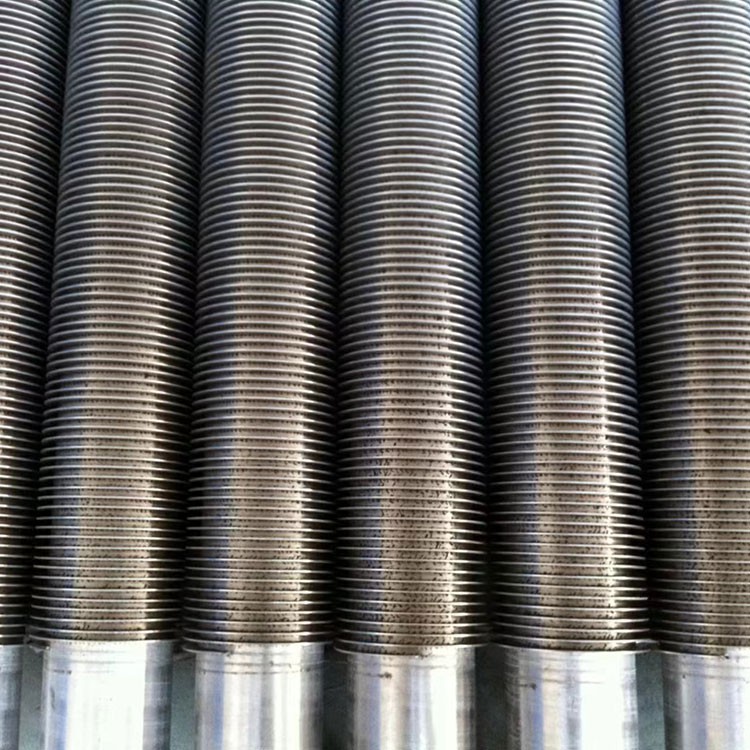
The geometry of the tube and the fins also plays a significant role. The fin height, fin thickness, and fin pitch can all affect the vibration response. For example, tubes with taller fins are more likely to vibrate than tubes with shorter fins because the taller fins have a larger surface area exposed to the fluid flow.
Fluid Properties
The properties of the fluid, such as density, viscosity, and temperature, can also influence the vibration characteristics. Fluids with higher densities and viscosities tend to generate more drag force on the tube, which can increase the likelihood of vibration.
Mounting Conditions
The way the tube is mounted can also affect its vibration behavior. Tubes that are rigidly mounted are less likely to vibrate than tubes that are loosely mounted. The support spacing and the type of support also play a role in determining the vibration response.
How We Ensure Quality in Our Longitudinal Finned Tubes
At our company, we understand the importance of controlling the vibration characteristics of our longitudinal finned tubes. We use advanced manufacturing techniques and quality control measures to ensure that our tubes meet the highest standards.
We offer a wide range of Laser Welded Stainless Finned Tube, Prime Longitudinal Finned Tube, and H-finned Tube. Our tubes are designed to minimize vibration and maximize heat transfer efficiency.
We conduct extensive testing on our tubes to evaluate their vibration characteristics. We use state-of-the-art equipment to measure the amplitude and frequency of the vibrations under different fluid flow conditions. This allows us to optimize the tube design and ensure that our tubes perform well in real-world applications.
Conclusion
In conclusion, the vibration characteristics of longitudinal finned tubes in fluid flow are complex and depend on several factors. While vibration can have some positive effects, such as improving heat transfer and preventing fouling, excessive vibration can also cause mechanical damage and noise problems.
As a supplier of longitudinal finned tubes, we are committed to providing high-quality products that meet the needs of our customers. If you're interested in learning more about our products or have any questions about the vibration characteristics of our tubes, please don't hesitate to contact us. We'd be happy to discuss your requirements and help you find the best solution for your application.
References
- Incropera, F. P., & DeWitt, D. P. (2002). Fundamentals of Heat and Mass Transfer. Wiley.
- White, F. M. (2006). Fluid Mechanics. McGraw-Hill.
- Chen, J. C. (1987). Heat Transfer in Finned Tubes. Hemisphere Publishing Corporation.